Does an Absolute Address change?
1. Introduction
In computing, an absolute memory address is a unique identifier that specifies a precise physical location within the computer's memory (RAM). Think of it like a unique street address for every single house in a city. The CPU uses these addresses to find and retrieve data or execute instructions. For anyone delving into programming, especially in languages like C or C++, understanding memory addresses is fundamental. A common question that arises is whether these addresses are static or if they can change. This article explores that very question.
2. Explanation
In the early days of computing, programs often directly manipulated physical memory addresses. However, this approach is inflexible and dangerous, as one program could easily corrupt another's memory. Modern operating systems (like Windows, macOS, and Linux) solve this with a crucial concept: virtual memory.
Instead of giving a program direct access to physical RAM, the operating system gives each program its own private, isolated address space, known as a virtual address space. The addresses your program sees and uses are virtual addresses, not physical ones. The operating system, with help from the hardware's Memory Management Unit (MMU), is responsible for translating these virtual addresses into actual physical addresses in RAM on the fly.
This system provides two major benefits:
- Isolation: Since each program has its own virtual space, it cannot accidentally access or modify the memory of another program, leading to a more stable and secure system.
- Flexibility: The OS can move a program's data around in physical RAM as needed to manage memory efficiently, without the program ever knowing. The mapping from virtual to physical addresses is simply updated.
3. Does it change when a program or a game gets recompiled?
Yes, absolutely. An absolute address is almost guaranteed to change when a program or game is recompiled, and it will very likely change even when you run the same compiled program multiple times. There are two primary reasons for this.
A. The Compilation and Linking Process
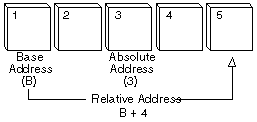
When you compile source code, the compiler translates your code into machine instructions and organizes data (variables, constants, etc.). The linker then pieces together all the different parts of your code and any libraries you use into a single executable file. During this process, it decides the layout of the program in memory—assigning relative addresses or offsets to functions and variables.
If you change even a single line of code and recompile, the size or order of functions and data can shift. This causes the compiler and linker to create a new memory layout, meaning the offsets of nearly everything can change. When the program is loaded into memory, these new offsets result in completely different absolute virtual addresses.
B. Address Space Layout Randomization (ASLR)
Even more significant is a security feature used by all modern operating systems called Address Space Layout Randomization (ASLR). ASLR is designed to prevent certain types of security exploits (like buffer overflows) by making it harder for an attacker to predict where code and data are located in memory.
Every time you launch an ASLR-enabled application, the operating system intentionally loads its major components (the executable itself, the stack, the heap, and linked libraries) at random, different base addresses in the virtual memory space. Therefore, the absolute address of a specific variable or function will be different on every single run, even without recompiling the program.
4. Conclusion
To summarize, absolute memory addresses are not static or predictable in modern computing. They are virtually guaranteed to change for several reasons:
- Recompilation: Modifying and recompiling source code changes the program's internal layout, resulting in new memory addresses.
- Operating System Abstraction: Programs operate within a virtual address space, which is managed and mapped to physical memory by the OS. This mapping is dynamic.
- Address Space Layout Randomization (ASLR): For security, the OS deliberately randomizes the base addresses of a program each time it is executed.
Because of this dynamic and unpredictable nature, hardcoding or relying on fixed memory addresses is an extremely fragile practice that will inevitably fail. Programmers should instead rely on pointers and references, which allow the program to work correctly regardless of where the OS decides to place its data in memory.